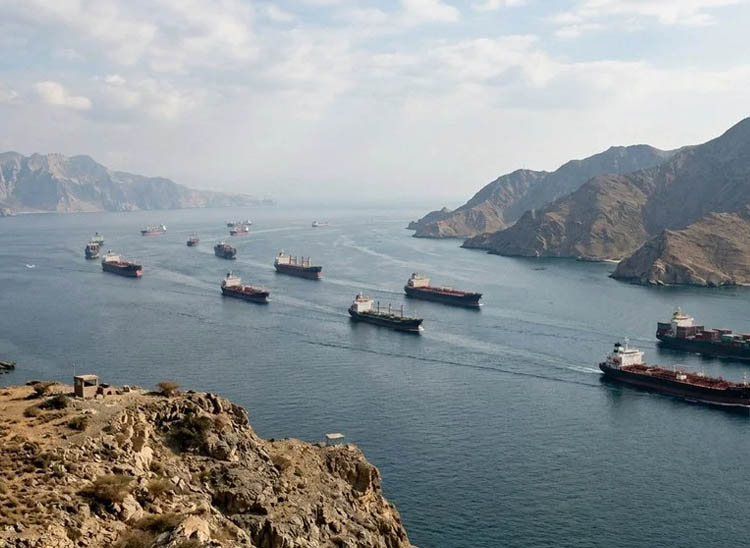
The Strait of Hormuz has served as a diplomatic bridge between Iran and the United States regarding ceasefire negotiations, but what explains its relevance?
The Strait of Hormuz lies between Iran and Oman, connecting the Persian Gulf to the Gulf of Oman and the Arabian Sea, and it is one of the world’s most strategic geographic points for global trade.
It plays a fundamental role in the global energy market due to the volume of oil and gas that passes through it. In 2024 and during the first quarter of 2025, one fifth of the world’s consumption of oil, petroleum products, and natural gas passed through the strait, according to the U.S. Energy Administration.
Saudi Arabia, Iran, the United Arab Emirates, Kuwait, and Iraq — all members of the Organization of the Petroleum Exporting Countries (OPEC) — export most of their oil through the waters of the strait.
While Saudi Arabia transports most of its oil and condensates — a lighter and more volatile gaseous mixture than crude oil — through the strait, Qatar exports most of the world’s liquefied natural gas.
It is estimated that 84% of the oil and 83% of the natural gas that passed through the strait in 2024 were directed toward Asian markets.
China, India, Japan, and South Korea were the main destinations for the oil transported through the strait, accounting for a combined 69% of all crude oil and condensate flows from Hormuz in 2024.
Although Europe is less dependent on the energy resources passing through the Strait of Hormuz, it could still face devastating repercussions resulting from rising global oil and gas costs if Iran were to close the strait.
It is impossible to predict how long such a blockade would last, but it is already affecting oil and natural gas prices, shipping costs, and travel expenses. If prolonged, it will lead to higher energy prices — including electricity — as well as increased fuel, food, and other goods and services costs. Furthermore, there is the risk of rising inflation and higher central bank interest rates, which would also affect mortgage loans.
As an alternative to this deadlock, world leaders should strategically devise a “Plan B,” such as creating new possible routes.
For example, the United Arab Emirates developed a pipeline connected to the Fujairah terminal in the Gulf of Oman, enabling the transport of up to three quarters of its oil production, equivalent to 10% of the strait’s oil traffic. The UAE also has a direct connection to Qatar through the Dolphin gas pipeline.
On Iran’s side, there are also alternatives through the Goreh–Jask pipeline, inaugurated in 2021.
However, all these options combined cannot replace the Strait of Hormuz, although they may reduce the impact on the global economy.
The global economy cannot depend solely on the diplomatic convergence of a few countries, but must instead seek valid alternatives for situations in which international law has not been applied.
And this responsibility belongs specifically to political leadership.
 * University Lecturer
Financial Consultant