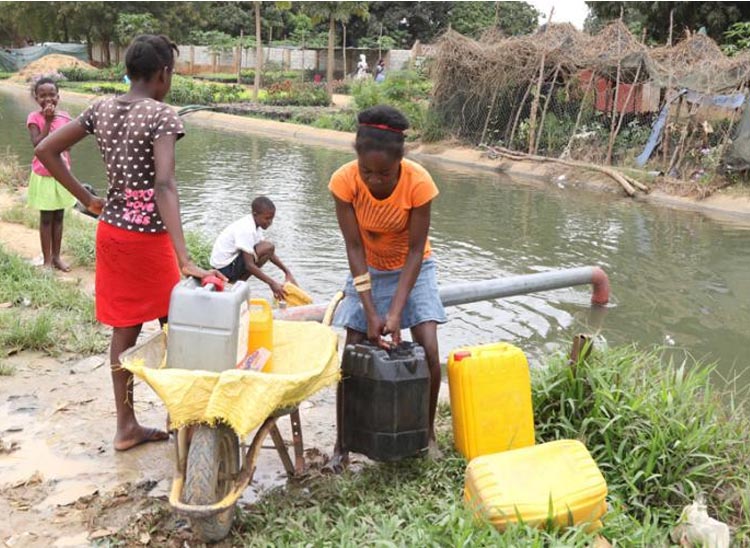
Participants at the 4th Luanda Biennale on Friday called for stronger water governance across Africa as a tool to prevent conflict, promote peace and strengthen regional integration. The position is contained in the Luanda Declaration, which brings together the main conclusions of the Pan-African Forum for the Culture of Peace and Non-Violence in Africa.
Produced as part of the work promoted by the Angolan Government, the African Union Commission and UNESCO, the declaration warns of the impact of climate change, prolonged droughts, floods and the degradation of rivers and lakes on food security, political stability and the survival of communities. The document states that more than 90 percent of the continent’s surface freshwater resources are distributed across 73 transboundary river basins, on which more than 70 percent of Africa’s population depends.
Despite this dependence, only 29 percent of Africa’s international river basins are covered by formal joint management agreements, while less than 10 percent of transboundary aquifers are managed cooperatively. In response, participants recommended strengthening water diplomacy, sharing technical data in real time and creating, by 2030, management bodies for all shared basins, with technical and financial autonomy.
The Luanda Declaration also recommends that the African Union Commission integrate water diplomacy more effectively into the continental early warning system in order to identify risks and allow intervention before conflicts erupt. The document further calls for the protection of civilian water infrastructure during armed conflicts and condemns the destruction or contamination of water sources.
On social inclusion, participants proposed a minimum 40 percent representation of women in water resource management committees, with a view to achieving parity by 2036, and recommended greater support for youth-led innovation in water, sanitation and environmental monitoring. In the area of investment, Angola’s drought-mitigation infrastructure in the south of the country, including the Cafu Canal and water retention and transfer systems linked to the Bue and Calucuve dams, was cited as a reference.
The document also urges African governments to allocate at least 1.2 percent of Gross Domestic Product to the water sector and proposes an implementation roadmap for the 2026-2036 period, based on legislative harmonisation, infrastructure expansion and universal access to drinking water and safe sanitation. It also recommends the creation of a permanent tripartite committee comprising the Angolan Government, the African Union Commission and UNESCO to monitor the commitments, while proposing that the declaration be presented at the United Nations Water Conference scheduled for December in Abu Dhabi.
24/10/2026