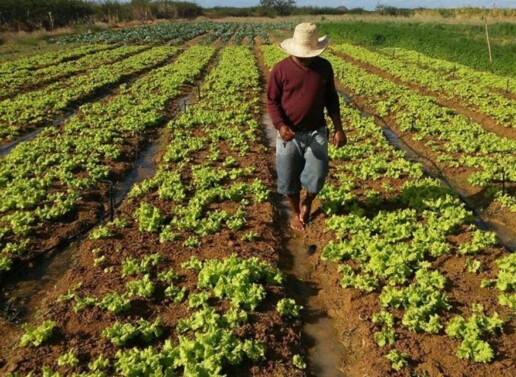

Farmers argue that the current framework of the sector does not allow the country to achieve economic diversification nor the fight against hunger and poverty.
The inoperability of four tomato-processing factories in Namibe, Huíla, Bengo and Benguela — officially considered leverage points for the agricultural sector and designed to “boost sustainable agriculture and food processing both for local consumption and for export” — is pointed out by farmers as one of the main causes of production and financial losses in the sector.
In general, the main losses occur due to inadequate storage conditions, transport failures, and the need to sell the product quickly at low prices before it spoils. As a result, part of the surplus is sold to cattle breeders, with prices ranging between 10,000 and 70,000 kwanzas, depending on the weight of the product.
Carlos Damião, president of the Cooperative of Cattle Breeders and Farmers of Southern Angola, identifies other wasted inputs such as water, land, energy, and labour. “In various regions of the country, we have been recording considerable product losses due to a lack of proper distribution. Added to this is the fact that we have recorded significant financial losses due to the lack of product processing centres, because many times there is surplus and we do not know how to deal with it,” he says.
According to Carlos Damião, building processing and storage centres contributes to food preservation and waste reduction, since such centres use technologies to transform production surpluses into longer-lasting products, such as juices, tomato paste, preserves, and other foods with greater shelf life.
José dos Santos, president of the Confederation of Farmers’ Associations and Agricultural Cooperatives of Angola, says it is an issue long needed by farmers, and laments that major agricultural processing projects have remained stagnant.
“Everything is at a standstill; every year there are always losses that we cannot even calculate. And more: whoever sells the remaining production never manages to cover production costs. Therefore, it is not good for the country that every year production is wasted for reasons we all know,” he explains, arguing that the current framework does not allow the country to achieve economic diversification nor to fight hunger and poverty.
Namibe, Huíla, Bengo, and Benguela are the provinces equipped with tomato-processing factories which, unfortunately, are inoperative, which “has contributed to the waste and scarcity” of the product in different seasons of the year.
The tomato concentrate factory in Matala, Huíla, whose inauguration was scheduled for 2008, needed a packaging assembly line and other equipment to start operating and reduce production surpluses. The reactivation of the factory, which stopped operating in the 1980s, was financed by the Angola Development Bank (BDA) in 2008 with more than 801 million kwanzas. However, it never resumed activities despite several inauguration announcements.
In September this year, the Minister of State for Economic Coordination, José de Lima Massano, promised, during a working visit, the recovery of the Namibe processing factory within six months. The factory’s operations have been paralysed for almost 10 years, having cost the State 600 million kwanzas.
Meanwhile, the tomato concentrate factory in the Dombe Grande commune, Benguela, with a processing capacity of 150 tonnes/day, was expected to begin operating in March 2024, which did not happen. The unit, which aims to transform tomatoes into paste or pulp, had a considerable part of its equipment vandalized, as revealed to Valor Económico by José dos Santos. At the moment, the company that took over the factory — the Adérito Areias Group, under the Propriv privatization program — has conducted a thorough assessment of the damage.
The tomato and banana processing factory located in the Caxito Agro-industrial Complex is in a state of abandonment, according to a report by this newspaper earlier this year. On November 18 this year, Valor Económico published a report revealing that the Angolan Society of Business and Participations, which won the public tender for the complex, still remained in possession of the asset six months after Propriv had announced its victory in court for the unit’s return to the State.
Valor Económico, 12/03/2025