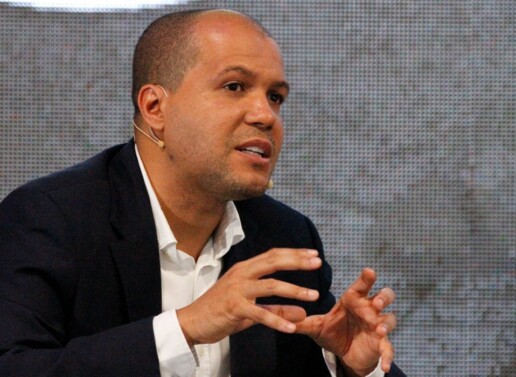

The founder and chief executive officer of Fly Angola, Belarnício Muangala, believes that the Angolan State has taken on a dual role in the civil aviation sector, acting simultaneously as both “referee and player.” According to him, this situation discourages private investment and makes it impossible to build a truly competitive market.
“A competitive existence in aviation is not possible. That explains why no one wants to invest in this sector,” he said in an interview, stressing that the current model of State intervention is the main obstacle to the development of Angola’s aviation industry.
In an interview with Jornal Valor Económico, Muangala warned that, although legislation allows the participation of private operators in regular air transport, the State continues to control the main structures and strategic decisions — from the national carrier TAAG to the management of airports.
“The current system does not encourage private investors. The State owns the flag carrier, the airport operator, the handling company, and even the catering service. This creates unequal opportunities and discourages investment,” he pointed out.
According to the businessman, aviation is not included in Angola’s economic incentive programs, which worsens the difficulties in obtaining financing and expanding private companies.
“There is no clear development program for the sector. Air transport is not covered by the National Bank of Angola’s incentive schemes, unlike agriculture or tourism,” he lamented.
Example of the Catumbela–Windhoek Route
Fly Angola launched the international Catumbela–Windhoek route between Angola and Namibia in early 2024 but suspended operations six months later due to a lack of incentives and institutional support.
“Namibia granted us a six-month exemption from airport fees. On the Angolan side, we received nothing. This difference in development policies explains why the route failed,” the CEO explained.
Muangala said the project aimed to strengthen the connection between the two countries and promote the use of the recently certified Catumbela International Airport. However, “the absence of incentives made it impossible to sustain operations.”
Airport Management and Lack of Competition
The Fly Angola CEO argues that centralized airport management by the public company AIAS, E.P. prevents liberalization and competition within the sector.
“Airport fees are set by decree. The airport operator has no power to negotiate directly with airlines. That makes the system rigid and unattractive,” he criticized.
Muangala believes that airports should compete with each other to attract operators and passengers, thereby creating a healthier market environment.
“Airlines should be able to choose where to operate based on commercial conditions — not political decisions,” he emphasized.
State Awareness but No Change
The businessman claims that the State itself is aware of the limitations it imposes on the sector, recalling that the Competition Regulatory Authority conducted a study in 2020 identifying the same problems. However, no meaningful reforms have been implemented since then.
“The reforms exist only on paper. The regulations allow private participation, but the State, which also competes in the market, is the one enforcing them. It’s a political contradiction,” he observed.
Profitability and Ongoing Challenges
Despite the constraints, Muangala says Fly Angola remains operational and profitable, though it faces “enormous challenges.”
“We’ve proven that it’s possible to make the business profitable, but the margins in air transport are extremely thin under these conditions,” he acknowledged.
The company plans to expand its fleet in the coming months with at least two new aircraft. Yet access to bank financing remains a major obstacle.
“Banks demand high guarantees, and interest rates are incompatible with the aviation sector, which operates on very tight margins,” he explained.
Call for Liberalization and Cooperation
For the Fly Angola founder, the way forward lies in true market liberalization and stronger cooperation between public and private operators.
“TAAG should be seen as a partner, not a competitor. What we advocate is a complementary market where each operator contributes to the growth of national air transport,” he said.
Muangala concluded that in a country with 39 million inhabitants and vast territory, aviation should be regarded as a strategic driver of economic development.
“Air transport is a catalyst for tourism, investment, and growth. As long as the State continues to be both referee and player, the sector will never take off,” he concluded.
Profile
Belarnício Amício Ebo Muangala, born in Eastern Europe and raised in Dundo, Lunda-Norte, holds a degree in International Relations from Anhembi Morumbi University in São Paulo, Brazil. He also holds a postgraduate diploma in International Business and a master’s degree in Aviation Management from the Emirates Aviation University in Dubai, United Arab Emirates.
He founded Fly Angola in 2018, a private airline that operates domestic and regional air transport services.
30/10/2025